

Paintless Dent Repair: The Benefits, Limits and When to Call a Pro
You walk out to your car after a long day and find that a rogue grocery cart, a hailstorm, or a careless door from the next stall over has left its mark.
That sinking feeling is universal.
The good news?
Not every dent means an expensive body-shop visit, fresh paint, or days
without your vehicle. Paintless dent repair has changed the game for car
owners, and understanding your options could save you hundreds of dollars and a
lot of stress.
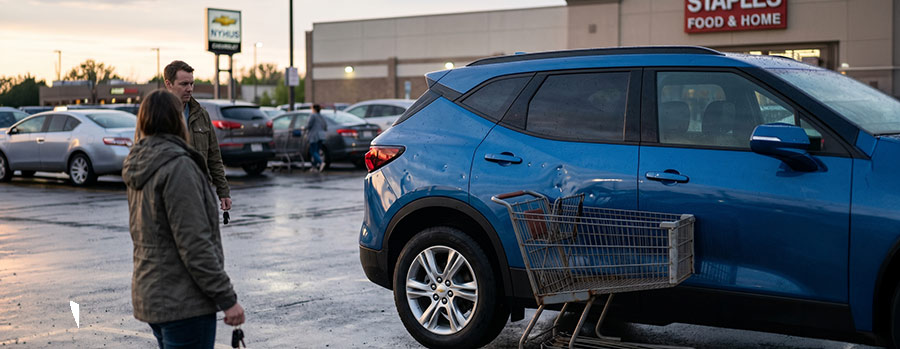
At Nyhus Chevrolet in Staples, we want you to be an informed vehicle
owner. Whether you bring your car to us or tackle a small job at home, this
guide covers everything, what paintless dent repair is, when it works, when it
doesn't, and what the do-it-yourself options really look like.
What Is Paintless Dent Repair?
Paintless dent repair, commonly called PDR, is a technique for removing
dents, dings, and minor creases from a vehicle's body panels without sanding,
filling, or repainting the surface.
Instead, a trained technician uses a set of specialized metal rods and
picks to gently massage the damaged panel back to its original shape from
behind. On the exterior, they may also use glue-pull systems that attach to the
dent face and pull it outward incrementally.
When the original factory paint can be preserved, the repair is almost
always stronger, faster, and less expensive than a conventional body-shop fix.
What Types of Dents Can Paintless Dent Repair
Fix?
PDR works best on specific types of damage. Understanding these
categories will help you decide which path makes sense for your situation.
Tiny dent repair: Small, shallow depressions from shopping carts, hail, or minor impacts
are the sweet spot for PDR. These are the cases where the technique truly
shines.
Door ding repair: Round, shallow dings from car-door contact in parking lots are usually
fixable in under 30 minutes with no paint work required.
Hail damage: Multiple small dents across panels and roofs from hailstorms are a core
PDR specialty. A skilled tech can work through dozens of hail dents in a single
session.
Crease dents: Longer linear dents from sliding impacts require more evaluation.
Shallow creases can often be improved significantly, though not always to 100%
perfection.
PDR is not the right tool when the paint has cracked, chipped, or been
scratched through to the metal.
In those cases, the damaged area
needs to be re-painted regardless, and a traditional body repair process makes
more sense. This is a common point of confusion: many people search for scratch
dent repairs expecting one unified solution.
In reality, a dent with broken paint is two separate problems. The dent can often still be massaged out first, but the scratch will still need color-matching and paint work afterward.
When Paint Scratches and Dents Overlap
It's worth spending a moment on scratch dent repair specifically, since
it's one of the most common questions we hear at our Staples service desk.
A scratch and a dent are distinct types of damage, even when they appear
together. A dent is a deformation of the metal panel beneath the paint. A
scratch is damage to the paint film itself, ranging from a light clear-coat
scuff to a deep gouge that exposes bare metal.
When someone brings us a door with both a dent and a scratch, we assess
them separately. If the paint over the dent is fully intact, PDR alone is the
answer.
If there's a scratch alongside the dent but the paint over the dent
itself is unbroken, PDR can remove the dent while the scratch is addressed with
touch-up paint or a blend repair.
Don't assume a dent with nearby scratches rules out PDR. Always get a
professional eye on it first.
How to Repair a Dent: The Professional
Process Step by Step
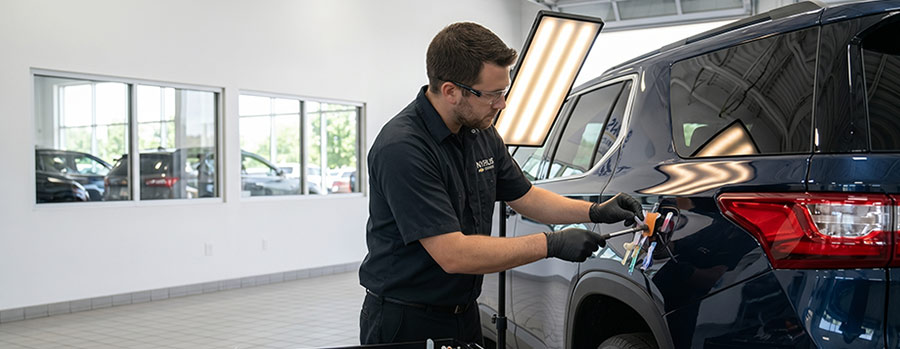
When you bring your vehicle in for professional paintless dent repair,
here's what the process typically looks like:
1. Assessment: The technician examines the dent under specialized lighting, often a
reflected light board, to see the true depth, shape, and extent of the damage.
2. Access: Interior panels, trim pieces, or plugs may be removed to give the tech
access to the back side of the damaged panel. For some locations like roofs or
pillars, a glue-pull system is used from the front instead.
3. Massage and manipulation: Using rods, picks, and tapping tools, the
technician applies gentle, controlled pressure to work the metal back into
position.
4. Final inspection. The panel is re-examined under the lighting board. Any remaining low
spots are carefully nudged out. The goal is a surface that's indistinguishable
from undamaged metal.
5. Reassembly. Any panels or trims that were removed are put back. In most cases, the
whole job takes between 30 minutes and a few hours, depending on the severity
and location of the damage.
Why Your DIY Dent Fix Might Cost You More
Than You Save
While DIY dent repair has surged in popularity, many home-repair
techniques only look achievable on camera.
Before you reach for a suction cup or a glue kit, it’s vital to
recognize that at-home bodywork is often a high-stakes gamble with your
vehicle’s finish and resale value.
The "boiling water trick" is a classic example of viral
misinformation; it only works on flexible plastic bumpers. Attempting it on
steel or aluminum is a waste of time, and if the temperature isn't just right,
you risk warping the plastic into a wavy, irreparable mess.
Even specialized tools have strict limits. Suction pullers require a
perfectly flat surface, meaning they fail the moment they hit a body line,
crease, or panel edge where the metal is reinforced.
Key Risks to Consider:
· Temperature Sensitivity: DIY glue-pull kits are notoriously finicky. If your workspace isn't between 20°C and 25°C, the adhesive may fail to bond or, worse, pull the clear coat right off the car.
· The "Mountain" Effect: It is incredibly easy to over-pull a dent. Turning a "valley" into a "mountain" often requires professional metal-tapping skills that a novice simply doesn't have.
·
Extra Costs: If you mess around too much by stretching the metal or cracking the
paint, you’ve graduated to a costly body shop job involving
sanding, repainting and your final costs multiplied.
The real risk isn't just a lingering dent—it’s turning a cosmetic
blemish into a structural nightmare. If the dent is near a panel edge or has a
sharp crease, the "save-a-buck" DIY route usually ends up costing
quadruple.
Small Dents Are Costing You More Than You
Think
Every season you wait on a dent, it's quietly costing you money.
Moisture works its way into tiny paint cracks, rust starts at the edges, and
your trade-in value drops a little more. Paintless dent repair is one of the
fastest, most affordable fixes in the automotive world but only when the paint
is still intact. Don't wait until a simple PDR job turns into a full panel
repaint.
Bring your vehicle by Nyhus Chevrolet in Staples today, and let's take care of it while the fix is still simple.